Attic Spray Foam Insulation (Roof-Deck / Conditioned Attic)
Roof-deck spray foam application converts a vented, unconditioned attic into a sealed, conditioned space that hits the R-49 Zone 5B insulation target in a single pass — protecting attic HVAC and ductwork while moderating, not eliminating, ice-dam risk at 6,400 feet.
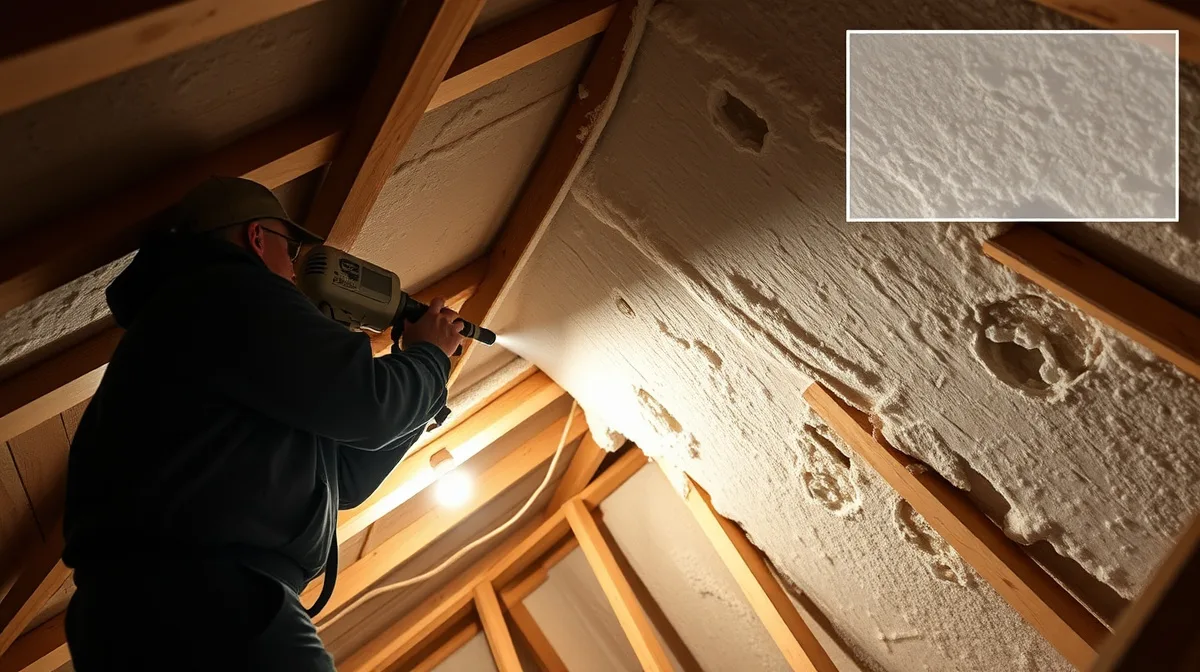
Most attic insulation in the White Mountains still gets installed the old way: blown-in fiberglass or cellulose laid across the attic floor, with the attic itself left vented, unconditioned, and exposed to whatever the sky is doing that day. We do it differently. As a spray-foam-only specialist, roof-deck application is one of the applications we run every week — spraying closed-cell or open-cell foam directly to the underside of the roof sheathing and rafters instead of the attic floor, which pulls the entire attic cavity inside the home's conditioned building envelope. The attic stops being a vented, outside-temperature space and becomes part of the house. That's a structurally different approach than a general insulation contractor topping off attic-floor batts with a truck-mounted blower, and it's why we treat attic spray foam as its own application, engineered around the roof-deck geometry of each Show Low home rather than a one-size material swap.
At 6,400 feet in IECC Climate Zone 5B, the attic is doing real work all year — holding back genuine sub-freezing winter nights and carrying summer heat gain the rest of the year. A properly executed roof-deck application hits the R-49 attic target the region calls for in a single pass, closes the air leaks that batts and blown-in fiberglass can't touch, and — because so many White Mountains homes route HVAC equipment and ductwork straight through the attic — brings that equipment inside the conditioned envelope instead of leaving it to lose or gain energy against outside air all day. It also moderates, though doesn't eliminate, ice-dam risk: Show Low's roughly 19 inches of snow a year is nowhere near Flagstaff's 90-108, so ice dams are a real but secondary consideration here, and a sealed conditioned attic simply removes one of the mechanisms — escaping attic heat melting snow from below — that makes them worse.
Why homeowners choose it
- Converts a vented, unconditioned attic into a sealed space inside the home's conditioned envelope
- Hits the R-49 Zone 5B attic target in one application, no layering multiple insulation types
- Brings attic-routed HVAC equipment and ductwork inside the thermal envelope instead of exposing it to outside-air swings
- Air-seals and insulates in the same pass — no separate air-sealing contractor or step
- Moderates, without overselling, ice-dam risk by reducing attic-to-roof-deck heat loss
- Cuts the heating-cost swings that come with a leaky, vented attic at 6,400 feet
Roof-Deck Application vs. the Vented Attic-Floor Approach
A vented attic-floor approach insulates the floor between living space and attic, then leaves gable or soffit vents open so the attic itself stays at roughly outdoor temperature year-round. Roof-deck spray foam application moves the insulation boundary up to the roof itself — foam gets applied directly to the underside of the roof sheathing, rafters, and gable end walls, sealing the entire attic cavity as part of the conditioned house. Vents get closed off or eliminated as part of the job, since an unvented conditioned attic doesn't rely on outside airflow to manage moisture the way a vented attic does. We handle the transition detailing around chimneys, plumbing stacks, and roof penetrations in the same application, because a sealed attic only performs if every penetration is actually sealed, not just the open rafter bays.
- Foam applied to roof sheathing, rafters, and gable ends, not the attic floor
- Existing ridge, soffit, and gable vents closed off or eliminated as part of the job
- Chimney chases, plumbing stacks, and roof penetrations detailed and sealed in the same pass
- Attic becomes conditioned space instead of an outside-temperature cavity
Hitting the R-49 Zone 5B Attic Target
Show Low's IECC Zone 5B attic target sits at R-49, and roof-deck application is how we get there without stacking multiple insulation systems. Closed-cell foam runs roughly R-6 to R-7 per inch, so a rafter bay with 7-8 inches of depth can clear R-49 with closed-cell alone in a single lift, which is why closed-cell is the default choice on tighter rafter bays or roofs with limited depth. Open-cell runs lighter at roughly R-3.5 to R-3.7 per inch — it needs more depth to hit the same number, but it costs less and fills deep rafter bays completely, which is often the more economical route on new construction with full-depth trusses. Plenty of Show Low attics end up running a hybrid: closed-cell against the roof deck for the moisture and air-seal benefit, open-cell filling out the rest of the cavity depth to close out R-49 without the deep-cavity cost premium of closed-cell alone. We size the exact lift thickness and material mix to your actual rafter depth and roof geometry during the on-site assessment, not off a generic chart.
Protecting HVAC, Ductwork, and Moderating Ice-Dam Risk
A lot of White Mountains homes run the furnace, air handler, or a good stretch of supply ductwork straight through the attic — and in a vented attic, that equipment sits in a space that can swing close to outside temperature on both ends of the year. Sealing the attic into the conditioned envelope with roof-deck spray foam keeps that equipment and ductwork in tempered space instead, cutting the standby losses and condensation risk that come with running ducts through an unconditioned cavity. It's also worth being direct about ice dams, since it comes up constantly in the White Mountains: Show Low's roughly 19 inches of snow a year is a fraction of Flagstaff's, so this isn't a heavy ice-dam market, and we don't sell this as an ice-dam-prevention service. What a sealed, conditioned attic does is remove one contributing factor — attic heat escaping upward and melting roof snow from underneath, which refreezes at the colder eave and forms a dam. That's a real, meaningful reduction in risk, not an elimination of it, and it's a side benefit of the R-49 application, not the reason to do the job.
- Furnaces, air handlers, and supply ductwork routed through the attic
- Attic-stored HVAC components otherwise exposed to summer heat gain and winter cold
- Roof-deck moisture points where warm, humid air meets cold sheathing
Ideal for
- Homes with a furnace, air handler, or ductwork routed through the attic
- Homeowners replacing sagging, moisture-damaged, or rodent-disturbed blown-in or batt attic insulation
- New builds and re-roof projects where the roof deck is open and accessible before decking closes up
- Homes with vaulted ceilings, dormers, or complex roof lines where a vented attic-floor approach leaves gaps
- Owners who want a real R-49 attic without gambling on a vented-attic energy-audit patch job
What affects the cost
Attic Spray Foam questions, answered
At roughly R-6 to R-7 per inch, closed-cell foam can clear R-49 in about 7 to 8 inches applied directly to the roof deck, depending on the exact product and rafter depth available. Plenty of Show Low attics use a hybrid lift instead — closed-cell against the deck for the air-seal and moisture benefit, open-cell filling the rest of the cavity — which reaches the same R-49 target at a lower material cost. We measure your actual rafter depth on-site rather than quoting off a generic number.
Both work in a conditioned attic, and the right call depends on rafter depth, budget, and vapor considerations more than a blanket rule. Closed-cell's higher R-value per inch and moisture resistance make it the default on shallower rafter bays or where roof-deck condensation control matters most. Open-cell costs less and fills deep cavities completely, which makes it a strong choice on new construction with full-depth trusses. Many of our attic jobs actually mix both in a single application.
Yes. Spray foam is applied around existing wiring, ductwork, and IC-rated recessed fixtures as standard practice — we detail around each penetration and fixture rather than foaming over anything that needs airflow or clearance, including non-IC recessed cans, which get boxed or excluded per code before the foam goes in.
It helps moderate ice-dam risk, but we won't oversell it as prevention. Show Low gets roughly 19 inches of snow a year — a fraction of what Flagstaff sees — so this isn't a heavy ice-dam climate to begin with. A sealed, conditioned attic reduces the attic heat loss that melts roof snow from underneath and causes refreezing at the eaves, which meaningfully reduces the risk. It doesn't eliminate ice dams entirely, and if ice dams are your primary concern rather than attic R-value and energy performance, that's worth discussing directly with us.
Attic roof-deck application typically runs in the same $1.50 to $5.00 per square foot range as spray foam generally, with open-cell toward the lower end and closed-cell or hybrid lifts toward the higher end, depending on rafter depth, accessibility, and whether old insulation needs to be removed first. A free on-site assessment is the only way to get a firm number for your specific attic and roof geometry.
Attic Spray Foam done right, by a local White Mountains crew
We're a spray-foam-only specialist — not a general insulation contractor that also offers spray foam as one option among many. Attic Spray Foam isn't a commodity, and the result depends entirely on how carefully it's scoped and installed for your specific home at 6,400 feet on the Mogollon Rim. We assess what your house actually needs, prep and air-seal properly, and install to your elevation-appropriate, IECC Zone 5B R-value target, so the work delivers the comfort and savings it's supposed to.
We serve Show Low, Pinetop-Lakeside, Taylor, Snowflake, Heber-Overgaard, Springerville, Eagar, and Concho. Show Low's winters are real — genuine heating loads at altitude — but drier and lighter on snowfall than Flagstaff, so we scope every job to the White Mountains' actual conditions rather than borrowing assumptions from a heavier-snow climate. Every job starts with a free, no-pressure quote.
Just as important, we treat your home like the system it is. Insulation, air sealing, and ventilation all interact, and getting one right while ignoring the others leaves comfort and savings on the table. When we scope your attic spray foam, we look at how it fits the whole picture — so the finished result performs the way it should, holds up through a genuine White Mountains winter, and actually lowers the bills you feel every month, whether you're served by Navopache Electric Cooperative or UniSource Energy Services.
Free assessment
We evaluate your home and give you a clear, itemized quote.
Expert install
We prep, air seal, and install your attic spray foam to spec — clean and on schedule.
Savings you can feel
A warmer home, lower heating bills, and honest advice about what your home needs.
Related services
Ready for a free attic spray foam quote?
Tell us about your home and we'll put together a clear, no-pressure spray foam insulation quote — built for Show Low's real winters.