Garage Spray Foam Insulation
Ceiling and wall spray foam insulation for attached and detached garages — closing the thermal gap that lets sub-20°F mornings pull heat out of the living space above and put stored plumbing, water heaters, and vehicles at freeze risk.
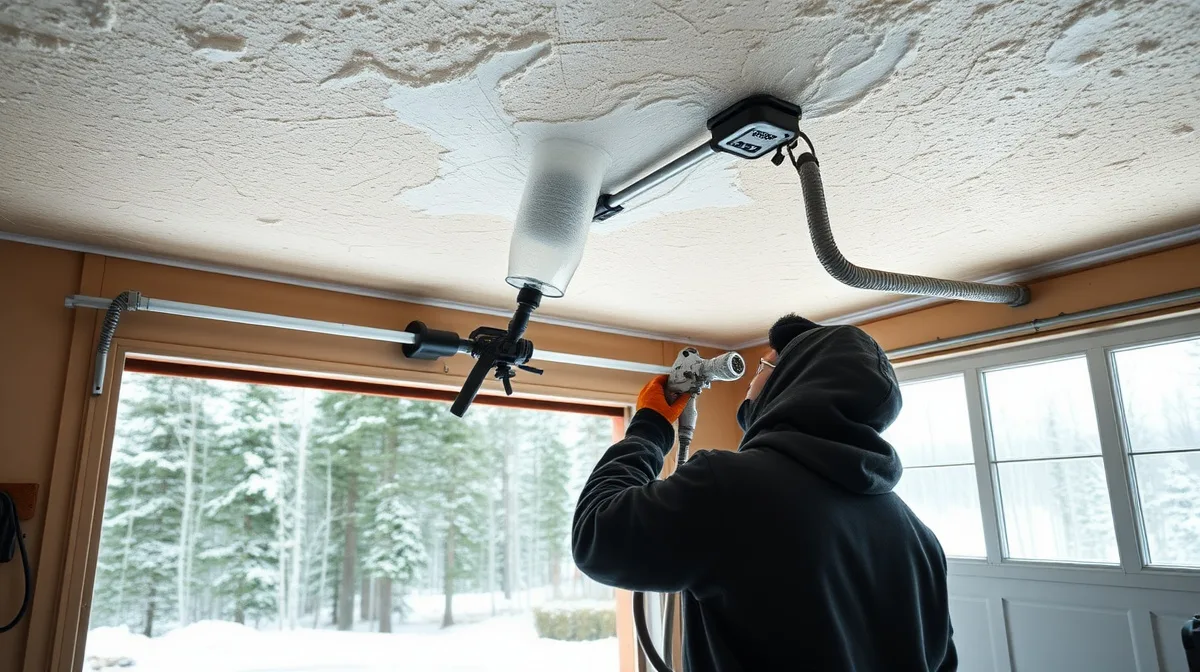
Most homeowners insulate everything in a house except the garage, then wonder why the room above an attached garage never quite holds heat, or why the hose bib on the garage wall freezes every winter. The garage ceiling and any shared walls are a direct thermal pathway between conditioned living space and a mostly unconditioned box, and in Show Low's four-season climate that pathway drains real heating dollars every month from October through April. We're not a general insulation company that treats the garage as a leftover corner job — spray foam is the only material we install, in every application in the house, which means we've already solved the specific cavity depths, joist bays, and rim-joist intersections that make garage ceilings and walls behave differently than a standard attic or exterior wall assembly.
Whether it's an attached two-car garage with a bonus room overhead or a detached shop building where you park a vehicle, store tools, or keep a spare freezer running year-round, we treat the garage envelope with the same rigor as the rest of the house. Show Low sits at roughly 6,400 feet in IECC Climate Zone 5B — genuinely cold, but notably drier than Flagstaff's heavy snow load — so garage spray foam here is really about steady, sustained cold transfer on routine sub-20°F mornings, not dramatic snow-driven ice events. Closed-cell foam on garage ceilings and shared walls closes that gap in one continuous air-and-thermal barrier, meaningfully reducing freeze risk for anything stored inside without pretending a garage becomes fully conditioned space.
Why homeowners choose it
- Stops the single biggest heat-loss pathway between an attached garage and the living space directly above it
- Protects garage-stored plumbing lines, water heaters, and hose bibs from freeze damage on sub-20°F mornings
- Continuous closed-cell air barrier eliminates the gaps and thermal bridging that batt insulation leaves at every joist and stud
- Keeps stored vehicles, tools, and equipment out of the worst temperature swings without heating the whole structure
- Adds structural rigidity to garage ceiling and wall assemblies while insulating in the same application
- One visit covers the ceiling, shared walls, and rim joist band together instead of three separate service calls
Why the Garage Is Show Low's Most Overlooked Thermal Gap
An attached garage is rarely conditioned space, which means it sits much closer to outside temperature than the rest of the house all winter. If the ceiling between that garage and a bonus room, bedroom, or home office above it is under-insulated, that floor assembly becomes a constant drain — warm air moving down into the garage and cold radiating back up, night after night. The same happens laterally through any wall shared between the garage and a heated room, like a mudroom or laundry wall that always feels a few degrees colder than the rest of the house. Batt insulation stuffed between joists and studs leaves gaps at every penetration, wire run, and framing member, so the assembly never actually performs at its rated value.
The garage's rim joist band, where the structure's sill meets the foundation, is another weak point that often gets skipped entirely during a standard build. It's a narrow, awkward-to-reach band, but it's also one of the highest-leakage spots in the whole envelope. Spray foam is suited to exactly this kind of irregular, hard-to-batt geometry — sprayed directly onto framing, it fills cavities completely and seals the small gaps that let cold air migrate in around the edges.
- Uninsulated or under-insulated ceiling below a bonus room, bedroom, or office
- Shared wall against a heated mudroom, laundry room, or living space
- Rim/band joist band where the garage framing meets the foundation
- Wire runs, plumbing penetrations, and framing gaps that batt insulation can't fully seal
Ceiling, Wall, and Rim Joist Application — Built for the Space You Have
Garage framing is often still exposed — no drywall on the ceiling joists or stud bays — which makes it one of the easier retrofit applications in the house. We spray the garage ceiling from underneath, filling joist bays completely so the room above gets a continuous thermal break without opening any flooring. Shared walls get the same treatment from the garage side. We generally recommend closed-cell foam for shared walls and the rim joist band, since its density and moisture resistance matter most where the garage envelope meets conditioned space or the foundation sill; open-cell can be the right call for a detached shop ceiling where budget and cavity depth make more sense and vapor exposure is less of a concern.
Detached garages need a different scope than attached ones — since there's no adjoining living space to protect, the goal shifts to insulating the full envelope (all exterior walls plus the ceiling or roof deck) so the structure itself holds a more stable temperature for whatever's stored inside. We scope attached and detached garages differently for exactly this reason rather than applying a one-size-fits-all package.
- Closed-cell foam for shared walls and the rim/band joist band
- Open-cell option for detached shop ceilings where budget and depth favor it
- Exposed framing in most garages makes this a faster retrofit than a finished room
- Attached and detached garages get different scopes based on what's being protected
Freeze Protection for What You Store in the Garage
A garage that sits close to outside temperature puts anything inside it — hose bibs, water lines routed through exterior walls, a garage-housed water heater, or a vehicle you'd rather not scrape frost off — at real risk on the kind of sub-20°F mornings that are routine here from December through February. Spray foam on the ceiling, shared walls, and rim joist band raises the baseline temperature the garage holds through a cold snap, buying meaningful time before exposed pipes or fixtures reach the freezing point. This is a proportionate benefit, not a guarantee: a detached, unheated garage that sits below freezing for days at a time still needs supplemental heat or heat tape on anything truly freeze-sensitive. Spray foam changes how fast and how far the space cools, not whether it can freeze at all.
For attached garages, the more immediate payoff is usually on the living-space side of the assembly: a bonus room or bedroom above the garage stops losing heat through the ceiling, and a shared laundry or mudroom wall stops feeling like the coldest room in the house.
- Protects hose bibs and water lines routed through garage walls
- Buys time before exposed pipes reach freezing during extended cold snaps
- Keeps a garage-housed water heater out of the most extreme temperature swings
- Reduces frost and condensation on vehicles stored overnight
- Complements, rather than replaces, heat tape or supplemental heat for critical lines
Ideal for
- Attached garages with a bonus room, home office, or bedroom directly overhead
- Detached garages or shop buildings used to store a vehicle, tools, or a spare refrigerator/freezer year-round
- Homes where a hose bib, water line, or water heater sits in or near the garage
- Garages with a shared wall against a heated room that always feels colder than the rest of the house
- New garage builds or additions where the ceiling and wall framing are still open and accessible before drywall
What affects the cost
Garage Spray Foam questions, answered
It helps meaningfully but doesn't eliminate freeze risk on its own. Closed-cell foam on the garage ceiling, shared walls, and rim joist band raises the baseline temperature the garage holds during a cold snap, which buys time before exposed pipes or hose bibs reach freezing. For a detached, unheated garage that sits below freezing for extended stretches, we still recommend heat tape or supplemental heat on anything truly freeze-sensitive alongside the foam.
It depends on what you're protecting. If the main concern is a bonus room, bedroom, or office above an attached garage, the ceiling and any shared walls are usually enough. If the garage itself needs to hold a more stable temperature — for stored plumbing, a water heater, or a detached shop — the full envelope, including all exterior walls, makes more sense.
It raises the baseline temperature and cuts down on drafts and cold radiating off the walls and ceiling, but a foam-insulated garage is not the same as conditioned living space. If you want the garage comfortable enough to work in through a Show Low winter, plan on supplemental heat in addition to the foam — the insulation makes that heat far more efficient to run.
We typically use closed-cell for shared walls and the rim/band joist, where moisture resistance and rigidity matter most. Open-cell can be the right call for a detached garage or shop ceiling where budget and cavity depth favor it and there's less vapor exposure to manage. We size the choice to each application rather than defaulting to one material for the whole job.
A garage envelope has specific challenges — exposed framing, shared walls with living space, a rim joist band, and freeze-protection stakes — that we deal with in every application in the house, every day. We're not a general insulation company that also does spray foam; spray foam is the only thing we do, which is why we get the material and application choices right the first time.
Garage Spray Foam done right, by a local White Mountains crew
We're a spray-foam-only specialist — not a general insulation contractor that also offers spray foam as one option among many. Garage Spray Foam isn't a commodity, and the result depends entirely on how carefully it's scoped and installed for your specific home at 6,400 feet on the Mogollon Rim. We assess what your house actually needs, prep and air-seal properly, and install to your elevation-appropriate, IECC Zone 5B R-value target, so the work delivers the comfort and savings it's supposed to.
We serve Show Low, Pinetop-Lakeside, Taylor, Snowflake, Heber-Overgaard, Springerville, Eagar, and Concho. Show Low's winters are real — genuine heating loads at altitude — but drier and lighter on snowfall than Flagstaff, so we scope every job to the White Mountains' actual conditions rather than borrowing assumptions from a heavier-snow climate. Every job starts with a free, no-pressure quote.
Just as important, we treat your home like the system it is. Insulation, air sealing, and ventilation all interact, and getting one right while ignoring the others leaves comfort and savings on the table. When we scope your garage spray foam, we look at how it fits the whole picture — so the finished result performs the way it should, holds up through a genuine White Mountains winter, and actually lowers the bills you feel every month, whether you're served by Navopache Electric Cooperative or UniSource Energy Services.
Free assessment
We evaluate your home and give you a clear, itemized quote.
Expert install
We prep, air seal, and install your garage spray foam to spec — clean and on schedule.
Savings you can feel
A warmer home, lower heating bills, and honest advice about what your home needs.
Related services
Ready for a free garage spray foam quote?
Tell us about your home and we'll put together a clear, no-pressure spray foam insulation quote — built for Show Low's real winters.