Rim Joist & Band Joist Spray Foam Insulation
Targeted closed-cell spray foam application to the rim joist and band joist cavity where the floor system meets the foundation or lower wall plate — sealing air leaks and insulating in a single pass to stop cold floors and cut heat loss at one of the leakiest spots in the house.
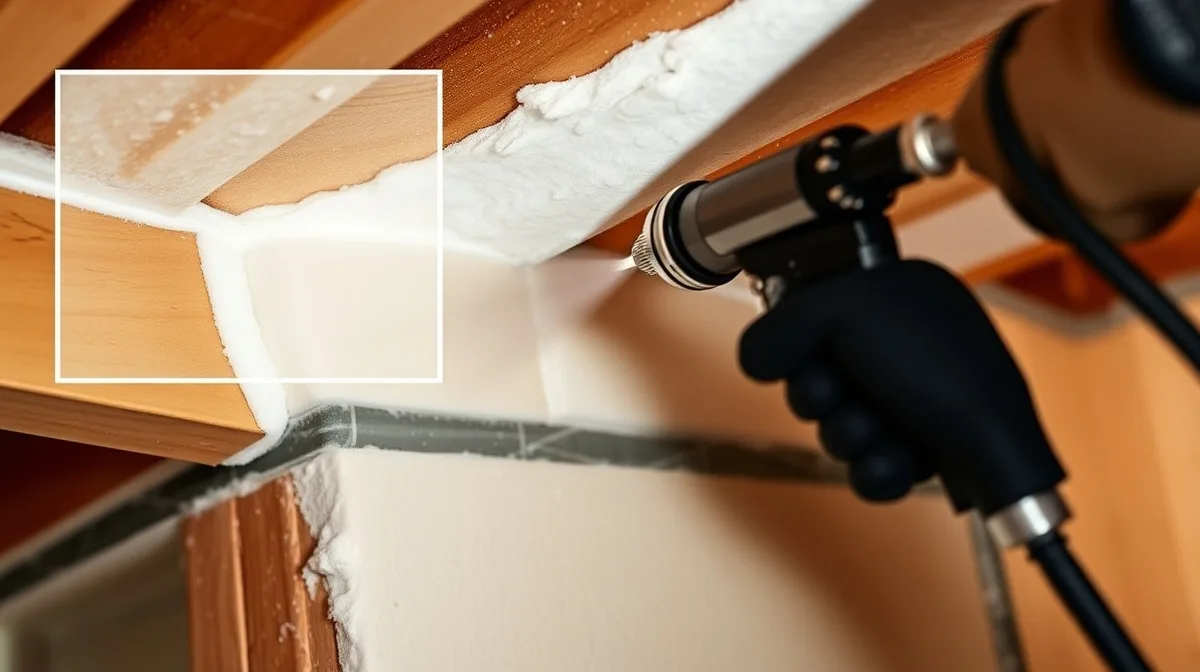
Spray foam is the only thing we do, which is why we do it better than anyone else in the White Mountains — and nowhere does that specialization show more than the rim joist. This narrow band of framing, where the floor system lands on the foundation wall or transitions between stories, is riddled with penetrations, seams, and thin wood that fiberglass batts were never built to seal. At 6,400 feet, in a genuine IECC Zone 5B climate, that gap is a direct highway for conditioned air to leave the house and cold air to creep in against the floor above it.
We treat the rim and band joist as its own precision job, not an afterthought tacked onto an attic or crawl space visit. Closed-cell spray foam goes on in a continuous, adhered layer that fills irregular framing bays, locks around joist ends, sill plates, and sistered lumber, and seals the wood-to-wood and wood-to-concrete seams that batts simply bridge over. Because closed-cell foam carries roughly R-6 to R-7 per inch and rigidifies as it cures, a couple of inches in this shallow cavity delivers both a real air barrier and meaningful thermal resistance — exactly what a narrow, structurally awkward space like this demands. It's a fast, contained scope of work, and it's frequently the highest-value square footage we insulate in any given house.
Why homeowners choose it
- Closed-cell foam seals irregular rim joist framing that batts and rolls can't conform to
- Stops the #1 cause of cold-floor complaints directly above unconditioned crawl spaces and basements
- Adds structural rigidity to the rim joist band, unlike any non-foam insulation option
- Moisture-resistant closed-cell formula guards wood framing against condensation at a classic cold-spot seam
- One targeted application seals air leaks and insulates in the same pass — no separate air-sealing step
- Reduces cold-air infiltration that drives up heating costs through the coldest months at elevation
Why the Rim Joist Is a Cold-Climate Weak Point
The rim joist band — sometimes called the band joist or box sill — is the strip of framing that caps the foundation wall and carries the floor system above it. It's perforated with joist ends, wiring and plumbing penetrations, and often a thin sill plate resting directly on masonry or concrete. Builders traditionally stuffed fiberglass batts into these bays, but batts don't stop air movement; they only slow conductive heat loss while air flows freely around, above, and below them. In a Zone 5B climate with a genuine freezing season, that unblocked air movement is exactly what makes floors feel cold and heating systems run longer than they should.
Because the rim joist sits low, right at the transition between conditioned living space and an unconditioned crawl space, basement, or garage, it's also a common path for cold air to stack against exterior walls and settle at floor level — the classic complaint of "cold feet" in an otherwise warm room. Sealing this band with closed-cell spray foam addresses the physics directly: it eliminates the air pathway and adds insulating value in the same layer, rather than treating symptoms room by room.
- Rim joist bays are irregular, penetrated, and structurally busy — a poor match for batt insulation
- Unsealed rim joists are a major air-infiltration point, not just a conduction loss point
- Closed-cell foam is the appropriate material here because of moisture resistance and rigidity, not just R-value
How We Apply Closed-Cell Foam to Rim & Band Joists
We access the rim joist from the crawl space, basement, or garage side wherever the framing is exposed, and spray closed-cell foam directly onto the band joist, sill plate, and the first several inches of the joist bays. The foam expands and adheres to wood, masonry, and metal fasteners alike, closing gaps around plumbing and electrical penetrations that would otherwise remain open even after a batt installation. Because the application is contained to a narrow band rather than a full cavity fill, most rim joist jobs are completed efficiently in a single visit, often paired with an adjacent crawl space or new-construction scope.
We build the foam to a thickness appropriate for the cavity depth and target performance, typically achieving a strong air seal and solid R-value in two to three inches given closed-cell's R-6 to R-7 per inch rating. On remodels where batts have already fallen or sagged out of rim joist bays — a very common finding in older White Mountains homes — we remove the failed material first so the foam bonds directly to clean framing.
- Direct spray application to band joist, sill plate, and joist bay ends
- Seals penetrations for wiring, plumbing, and dryer/bath vents that pass through the band
- Typically 1-2 inches of closed-cell, achieving air-seal plus insulation in one layer
- Removal of failed or sagging batt insulation before application on retrofit jobs
- Commonly paired with crawl space spray foam or new-construction rough-in visits
What Homeowners Notice After the Job
The most immediate change homeowners report is warmer floors on the level directly above the treated rim joist, particularly near exterior walls where the cold-air draft used to be noticeable. Because the rim joist ties into so many other assemblies — foundation, subfloor, exterior wall bottom plate — sealing it also reduces overall house-level air infiltration, which shows up as steadier indoor temperatures and less strain on the heating system during Show Low's coldest stretches.
This is deliberately a narrow, specialized scope of work. We're not selling a whole-house insulation overhaul here — we're sealing and insulating one specific, high-leakage assembly with the material actually suited to it. That's the specialist approach: go deep on the one thing (spray foam) at the one place it solves a problem better than any alternative, rather than treating it as a line item in a broader, generalist insulation package.
Ideal for
- Homes with cold floors on the level directly above a crawl space or basement rim
- Older Show Low, Pinetop-Lakeside, and Snowflake homes with fiberglass-batt rim joists that have settled, sagged, or fallen out
- New construction and remodels where the rim joist is open and accessible before drywall or finish flooring
- Homes getting a crawl space spray foam job, where the rim joist is the natural companion scope
- Anyone who's felt a draft along the baseboard on an exterior wall near the floor line in winter
What affects the cost
Rim Joist & Band Joist questions, answered
It's the framing member that caps the top of the foundation wall and runs around the perimeter of the house, supporting the ends of the floor joists above it. It's also called the band joist or box sill. This band is usually only accessible from a crawl space, basement, or garage ceiling.
The rim joist is a shallow, irregular, moisture-exposed cavity right at the foundation line. Closed-cell's higher R-value per inch (roughly R-6-7), moisture resistance, and rigidity make it the right material for this specific spot, even on projects that use open-cell elsewhere in the house.
It directly addresses cold floors on the level immediately above the treated rim joist, especially near exterior walls, since that's where the air leakage and conduction loss are concentrated. It's one part of a full envelope — paired with attic and wall performance, it has the biggest single impact on that specific cold-floor complaint.
Both. On existing homes we access the rim joist from the crawl space, basement, or garage and remove any failed batt insulation first. On new construction, we apply it during the rough-in stage while the band joist is fully open and before insulation inspection.
Most rim joist jobs are completed in a single visit, often the same day as a related crawl space assessment. Exact time depends on the home's perimeter length and access conditions. We'll give you a firm estimate after a free on-site assessment.
Rim Joist & Band Joist done right, by a local White Mountains crew
We're a spray-foam-only specialist — not a general insulation contractor that also offers spray foam as one option among many. Rim Joist & Band Joist isn't a commodity, and the result depends entirely on how carefully it's scoped and installed for your specific home at 6,400 feet on the Mogollon Rim. We assess what your house actually needs, prep and air-seal properly, and install to your elevation-appropriate, IECC Zone 5B R-value target, so the work delivers the comfort and savings it's supposed to.
We serve Show Low, Pinetop-Lakeside, Taylor, Snowflake, Heber-Overgaard, Springerville, Eagar, and Concho. Show Low's winters are real — genuine heating loads at altitude — but drier and lighter on snowfall than Flagstaff, so we scope every job to the White Mountains' actual conditions rather than borrowing assumptions from a heavier-snow climate. Every job starts with a free, no-pressure quote.
Just as important, we treat your home like the system it is. Insulation, air sealing, and ventilation all interact, and getting one right while ignoring the others leaves comfort and savings on the table. When we scope your rim joist & band joist, we look at how it fits the whole picture — so the finished result performs the way it should, holds up through a genuine White Mountains winter, and actually lowers the bills you feel every month, whether you're served by Navopache Electric Cooperative or UniSource Energy Services.
Free assessment
We evaluate your home and give you a clear, itemized quote.
Expert install
We prep, air seal, and install your rim joist & band joist to spec — clean and on schedule.
Savings you can feel
A warmer home, lower heating bills, and honest advice about what your home needs.
Related services
Ready for a free rim joist & band joist quote?
Tell us about your home and we'll put together a clear, no-pressure spray foam insulation quote — built for Show Low's real winters.