Wall Spray Foam Insulation
Stud-bay wall fill with open-cell or closed-cell spray foam that hits the R-20+5ci Zone 5B target, air-seals every cavity in the same pass, and shuts down the drafts and cold-wall complaints that plague older White Mountains site-built homes.
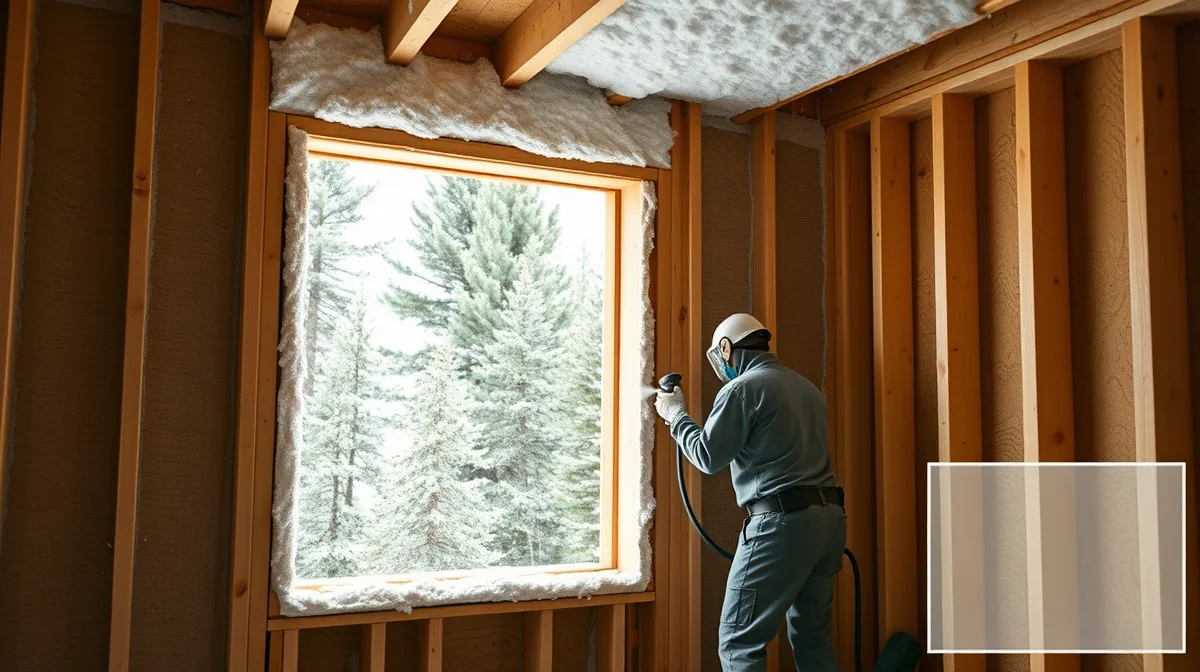
Walls are where most site-built homes in the White Mountains lose the fight against a 6,400-foot winter. Batt insulation gets stuffed into a stud bay, gaps form around wiring and electrical boxes, and the wall assembly ends up with an effective R-value well below what the label promised. Add in the top and bottom plate penetrations, the header over every window, and the inevitable compression where a batt got squeezed to fit, and you have a wall that's leaking conditioned air out of dozens of small gaps at once. Spray foam eliminates that math entirely. Because it's applied wet and expands to fill the entire cavity, it flows around wiring, boxes, and irregular framing and bonds directly to the studs, sheathing, and each other — no gaps, no compression, no guesswork.
We're not a general insulation company that also does spray foam — spray foam is the only thing we do, which is why we do it better than anyone else in the White Mountains. For wall assemblies we spec open-cell or closed-cell foam based on your cavity depth, vapor considerations, and budget, then apply it to hit the IECC Zone 5B wall target of R-20+5ci. That's a real number for a real cold climate — drier than Flagstaff's snowpack but still a genuine four-season freeze cycle that punishes an under-insulated wall every winter. Homeowners in older Show Low, Pinetop-Lakeside, and Taylor houses call us about the same two complaints: a cold wall you can feel from across the room, and a draft near outlets and window trim. Both are wall-cavity problems, and both are what stud-bay spray foam is built to solve.
Why homeowners choose it
- Fills the entire stud bay in one application, eliminating the gaps, voids, and compression points common with batt insulation
- Air-seals and insulates simultaneously — no separate air-sealing step or caulk-and-batt combination required
- Hits the R-20+5ci Zone 5B wall target with a single, correctly specified foam system
- Stops the cold-wall and draft complaints typical in older White Mountains site-built homes
- Expands around wiring, plumbing, and electrical boxes for a continuous thermal boundary
- Adds meaningful sound-dampening between rooms and from exterior noise, a common side benefit of open-cell fill
Open-Cell or Closed-Cell for Your Wall Assembly
Most interior and exterior stud-bay walls are a good fit for open-cell spray foam — at roughly R-3.5 to R-3.7 per inch, it fills a standard 2x4 or 2x6 cavity fully, air-seals as effectively as closed-cell in a wall application, and costs less installed. It's also vapor-permeable, which matters in a wall assembly where you want the structure to dry rather than trap moisture behind an impermeable barrier. Closed-cell earns its place in a wall system where cavity depth is limited, where added rigidity matters structurally, or where a specific moisture-control strategy calls for it — at roughly R-6 to R-7 per inch it reaches the target R-value in less depth, which is why we spec it for narrower framing or specific problem cavities rather than as a blanket default for every wall.
We walk every job site and make this call cavity by cavity when it's warranted, not off a one-size answer. A 2x6 exterior wall in a Show Low home built in the 1980s doesn't need the same spec as a tight remodel cavity or a mechanical chase — matching the foam to the assembly is how you hit R-20+5ci without over-spending on rigidity you don't need or under-shooting the vapor profile the wall requires.
- Open-cell: standard choice for most stud-bay walls, fills full cavity depth affordably
- Closed-cell: reserved for narrow cavities, added rigidity needs, or specific moisture-control cases
- Cavity-by-cavity assessment on-site, not a blanket spec for the whole house
- Both options air-seal fully — the difference is R-value density and vapor permeability
Why Batt Insulation Fails in Older White Mountains Walls
Batt insulation only performs at its rated R-value when it's installed with zero gaps and zero compression — a standard that's almost never met in real-world framing, especially in homes built decades before energy codes tightened. Wiring runs, electrical boxes, blocking, and irregular stud spacing all create spots where a batt gets notched, squeezed, or simply skipped. Each of those gaps is a direct path for conditioned air to leave the house and cold air to work its way in, which is exactly why a wall with 'R-19 batts' can still feel cold to the touch and drafty near outlets. The insulation isn't broken — the installation math was against it from the start.
Spray foam sidesteps the entire problem because it doesn't get installed around obstacles, it expands into them. Wiring, boxes, blocking, and odd framing all get fully encapsulated in foam rather than worked around, so the wall's actual performance matches its designed R-value instead of falling short of it. That's the difference homeowners feel within the first cold snap after the job — not just a warmer wall, but the elimination of the specific drafts they'd been living with for years.
What the Job Looks Like
Wall spray foam is most straightforward when cavities are open — new construction, additions, or a remodel where drywall is already off. Our crew masks off finished surfaces, protects windows and flooring, and sprays each stud bay to the specified thickness for open-cell or closed-cell, filling around every wire, box, and stud irregularity in the process. For homes where walls are already closed up, we scope the job on-site to determine whether a retrofit approach is viable for your specific wall assembly, since open-cavity application gives the most complete and verifiable fill. Either way, the assessment and quote are free, and we'll tell you plainly whether wall spray foam is the right call for your specific situation before you commit to anything.
Every job includes a walkthrough of what was sprayed and to what depth, so you know exactly what R-value the wall assembly is delivering, not just a general assurance that 'it's insulated now.'
- Free on-site assessment and cavity-by-cavity spec before any work begins
- Masking and protection of finished surfaces, windows, and flooring throughout the job
- Best suited to open stud bays — new construction, additions, and gutted remodels
- Post-job walkthrough confirming what was sprayed and the resulting R-value
Ideal for
- Older site-built homes in Show Low, Pinetop-Lakeside, or Taylor with visibly under-performing batt insulation
- Homeowners with a specific cold-wall or draft complaint near exterior walls, outlets, or window trim
- Remodels and additions where wall cavities are open and accessible before drywall goes up
- Homes with irregular framing, extensive wiring, or plumbing runs where batt insulation never fit cleanly
- Builders and owners targeting the full R-20+5ci Zone 5B wall assembly rather than cavity-only R-value
What affects the cost
Wall Spray Foam questions, answered
In almost every case, yes — cold spots and drafts near exterior walls are typically caused by gaps in batt insulation around wiring, boxes, or compressed sections, not a fundamentally bad wall design. Because spray foam fills the entire cavity and expands around those obstacles instead of working around them, it closes the specific gaps causing the cold-wall feeling. We'll walk your walls with you during the assessment and point out where the current insulation is likely falling short.
It depends on the wall. Open stud bays — new construction, additions, or a remodel with drywall already off — are the most reliable and verifiable scenario for a full, even fill. For finished walls, we'll assess your specific situation on-site to determine whether a viable approach exists for your framing and access, and we'll tell you honestly if a full retrofit isn't the right fit rather than force a job that won't perform.
Most stud-bay walls perform well with open-cell — it fills the full cavity depth, air-seals completely, and costs less installed. We reserve closed-cell for cavities where depth is limited, added structural rigidity matters, or a specific moisture-control need calls for it. We make this call wall-by-wall during the on-site assessment rather than defaulting to one option for the whole house.
That's the target we spec to for Zone 5B wall assemblies. The exact combination of foam type and thickness depends on your cavity depth and framing, which is why the on-site assessment matters — we'll spec the fill to reach that target for your specific wall construction, not just apply a generic thickness and hope it lands close.
For a typical single-family home with open stud bays, the spraying itself is usually completed in a single day, with masking and prep before and cure time after. Retrofit scenarios, larger square footage, or homes with more complex framing can extend that timeline — we'll give you a specific schedule during the assessment.
Wall Spray Foam done right, by a local White Mountains crew
We're a spray-foam-only specialist — not a general insulation contractor that also offers spray foam as one option among many. Wall Spray Foam isn't a commodity, and the result depends entirely on how carefully it's scoped and installed for your specific home at 6,400 feet on the Mogollon Rim. We assess what your house actually needs, prep and air-seal properly, and install to your elevation-appropriate, IECC Zone 5B R-value target, so the work delivers the comfort and savings it's supposed to.
We serve Show Low, Pinetop-Lakeside, Taylor, Snowflake, Heber-Overgaard, Springerville, Eagar, and Concho. Show Low's winters are real — genuine heating loads at altitude — but drier and lighter on snowfall than Flagstaff, so we scope every job to the White Mountains' actual conditions rather than borrowing assumptions from a heavier-snow climate. Every job starts with a free, no-pressure quote.
Just as important, we treat your home like the system it is. Insulation, air sealing, and ventilation all interact, and getting one right while ignoring the others leaves comfort and savings on the table. When we scope your wall spray foam, we look at how it fits the whole picture — so the finished result performs the way it should, holds up through a genuine White Mountains winter, and actually lowers the bills you feel every month, whether you're served by Navopache Electric Cooperative or UniSource Energy Services.
Free assessment
We evaluate your home and give you a clear, itemized quote.
Expert install
We prep, air seal, and install your wall spray foam to spec — clean and on schedule.
Savings you can feel
A warmer home, lower heating bills, and honest advice about what your home needs.
Related services
Ready for a free wall spray foam quote?
Tell us about your home and we'll put together a clear, no-pressure spray foam insulation quote — built for Show Low's real winters.