Open-Cell vs. Closed-Cell Spray Foam: Which Is Right for Your White Mountains Home?
If you're planning a spray foam project for a home in Show Low, Pinetop-Lakeside, or Snowflake, the first real decision isn't whether to spray foam — it's which one. Open-cell and closed-cell are both spray polyurethane foam, but they behave differently once they're inside a wall cavity, an attic roof deck, or a crawl space at 6,400 feet. Get the choice right and you hit your R-value target, control moisture, and keep the budget in line. Get it wrong and you either overspend on cavities where open-cell would have done the job, or undersize a rim joist that really needed closed-cell's density. This is a technical decision, not a coin flip — so let's walk through the physics and the dollars behind it, framed specifically for IECC Climate Zone 5B.
R-Value Per Inch: The Physics That Drives Every Other Decision
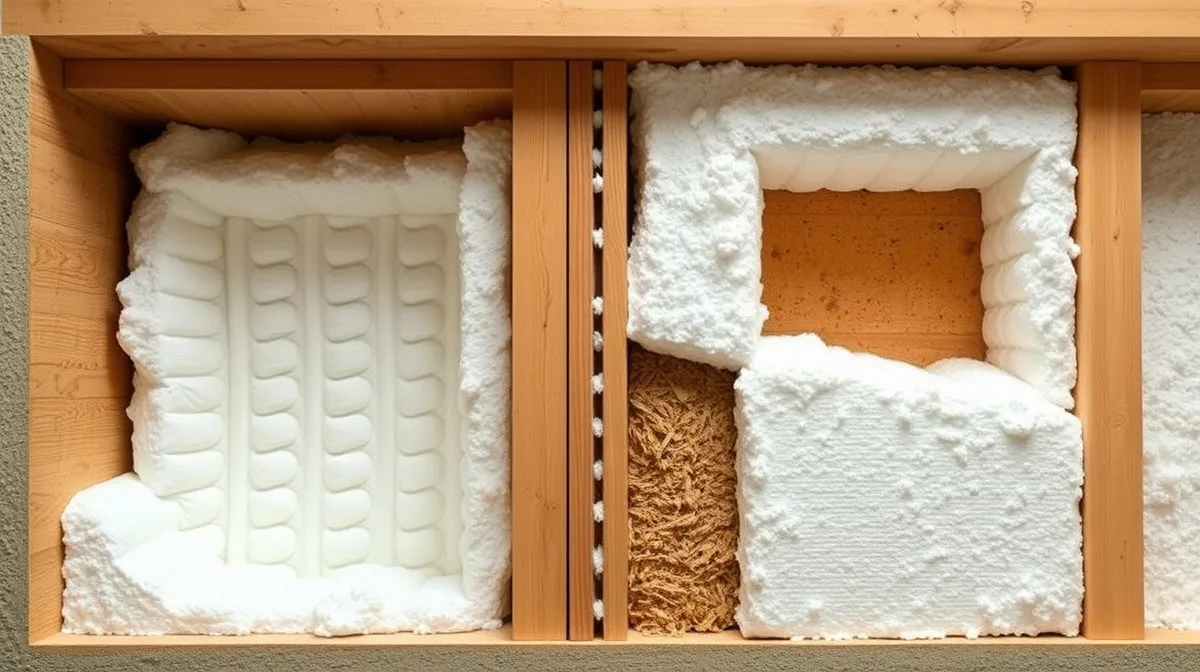
The single biggest technical difference between the two materials is density, and density is what determines R-value per inch. Open-cell spray foam runs roughly R-3.5 to R-3.7 per inch — its cell structure is exactly what the name says, open, which lets it expand more per pound of material and stay lighter and softer. Closed-cell spray foam runs roughly R-6 to R-7 per inch because its cells are fully closed and packed with a low-conductivity gas, giving you nearly double the thermal resistance in the same physical space. At sea level in a mild climate, that gap might not matter much. At 6,400 feet in Zone 5B, chasing R-49 in an attic or R-30+ in a crawl space, it matters a lot, because cavity depth is finite. A 2x6 wall cavity gives you about 5.5 inches to work with either way; closed-cell gets you to roughly R-33 to R-38 in that same space, where open-cell tops out closer to R-19 to R-20. That's the whole decision in one sentence: closed-cell buys you R-value density, open-cell buys you cavity-filling volume at a lower cost per inch.
Vapor Permeability: The Difference That Doesn't Show Up on a Spec Sheet
R-value gets all the attention, but vapor permeability is what actually determines where each material belongs. Open-cell spray foam is vapor-open — it lets moisture vapor pass through it, which is exactly the behavior you want in an interior wall or a conditioned attic where the assembly needs to dry in whichever direction the season demands. Closed-cell spray foam acts as a vapor retarder at typical application thickness — it blocks moisture from moving through it, which is what you want in a crawl space rim joist sitting a few inches from bare earth, or a roof deck facing driving snowmelt. Get this backwards — vapor-open foam somewhere that needs a vapor block, or a vapor-blocking material trapping moisture against wood that needs to dry — and you're building a moisture problem into the house rather than solving one. This is the piece of the decision a homeowner comparing spec sheets online usually misses, and it's exactly why 'just use whichever is cheaper' is the wrong question to start with.
Cost: What You're Actually Paying For
Installed spray foam in the White Mountains typically runs $1.50 to $5.00 per square foot, with open-cell sitting at the lower end and closed-cell at the higher end of that range — the gap reflects both material cost and the greater R-value delivered per inch. That's not the whole cost picture, though. A few things worth knowing before you compare quotes:
- Open-cell costs less per board foot and expands to fill large cavities efficiently, which is why it's the common choice for full wall bays and conditioned attic decks where volume, not density, is the goal.
- Closed-cell costs more per board foot but adds structural rigidity to the assembly it's sprayed into — a real factor in older rim joists and crawl space perimeters that need racking strength, not just thermal performance.
- Closed-cell's higher R-value per inch can mean less material depth is needed to hit a target R-value in a shallow cavity, which sometimes narrows the price gap more than the per-board-foot numbers suggest.
- Every White Mountains home is a different combination of cavity depths, accessibility, and existing insulation to remove — a firm number comes from an on-site assessment, not a square-footage guess.
Where Open-Cell Wins in a White Mountains Home
Open-cell earns its place in this climate zone in a specific set of applications, and it's often the smarter call, not just the cheaper one:
- Interior stud-bay walls, where its vapor-open nature lets the assembly dry safely in either direction
- Conditioned attic roof decks, where lighter weight and lower cost fill large square footage efficiently
- Sound-dampening between floors or around home offices, a side benefit of its open cell structure
- Budget-conscious whole-house projects where hitting the R-20+5ci wall target matters more than squeezing extra R-value out of a shallow cavity
Where Closed-Cell Wins in a White Mountains Home
Closed-cell earns the extra cost in applications where density and moisture control matter more than raw volume:
- Rim joists and band joists, the leakiest, most temperature-exposed band in the house
- Crawl space walls and perimeters, where vapor blocking and freeze protection for exposed plumbing are the goal
- Shallow cavities — engineered joists, tight roof rafters, older 2x4 walls — where R-value per inch is the limiting factor
- Any application where the foam itself needs to add structural rigidity, not just fill space
Making the Call for Show Low, Pinetop-Lakeside, and Snowflake
Most White Mountains homes we work on don't use one material exclusively — they use closed-cell where density and moisture control earn their keep (rim joists, crawl spaces) and open-cell where volume and budget do the work (walls, conditioned attics). Elevation and Zone 5B targets don't change which material is 'better' in the abstract — they change where the cutoff sits. A Snowflake home sitting a little lower and drier than Show Low might lean more toward open-cell in the attic; a Pinetop-Lakeside cabin with an exposed crawl space and hard winters leans toward closed-cell there regardless. This is exactly the kind of decision that benefits from someone who only does spray foam looking at your specific cavities, not a generalist running through a standard spec sheet.
Frequently asked questions
Density. Open-cell spray foam has an open cell structure, runs about R-3.5 to R-3.7 per inch, stays lighter and softer, and is vapor-open. Closed-cell spray foam has a fully closed cell structure, runs about R-6 to R-7 per inch, is rigid, and acts as a vapor retarder. That density difference is what determines which applications each one is suited for.
It depends on the cavity depth and the type of attic. A roof-deck application converting to a conditioned attic can hit the R-49 Zone 5B target with either material given enough depth, but open-cell is the common choice for the large square footage involved, since it fills volume efficiently at lower cost. Shallow rafter bays or spaces where structural rigidity is also useful can tip the choice toward closed-cell. An on-site look at your actual cavity depth is the only way to give a firm recommendation.
Closed-cell is the standard recommendation for crawl space walls and rim joists in this climate. Crawl spaces sit close to bare earth and exposed plumbing, so the vapor-blocking property of closed-cell foam matters as much as its R-value — it keeps ground moisture out of the assembly while helping protect pipes from freeze risk during White Mountains winters. Open-cell's vapor-open nature is the wrong fit for that specific application.
In some applications, yes — in others, not necessarily. For rim joists and crawl spaces, closed-cell's density and moisture control justify the higher cost per board foot. For full wall cavities and conditioned attic decks where you have enough depth to hit your R-value target with either material, open-cell often delivers the same performance target for less money. The right answer changes cavity by cavity, which is why we quote by application rather than a single blanket price.
Ready for a free quote?
Tell us about your home and we'll build a clear, no-pressure quote.